
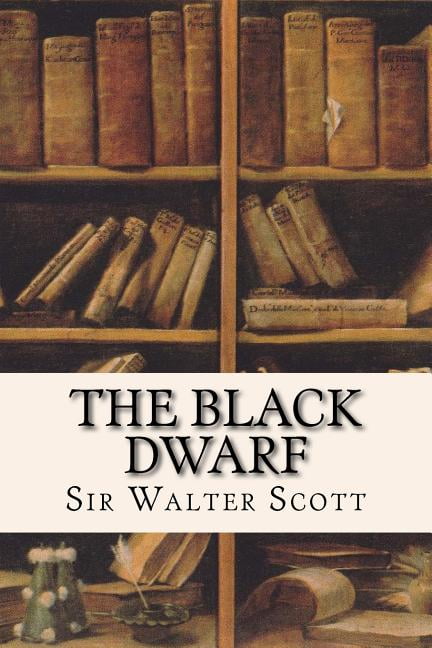
The Black Dwarf Paperback 154708541X 9781547085415 Sir Walter Scott
Product details
| Management number | 240117499 | Release Date | 2026/07/16 | List Price | US$2.40 | Model Number | 240117499 | ||
|---|---|---|---|---|---|---|---|---|---|
| Category | |||||||||
The Black Dwarf is a classic Sir Walter Scott story is set just after the Union of Scotland and England (1707), in the Liddesdale hills of the Scottish Borders, familiar to Scott from his work collecting ballads for The Minstrelsy of the Scottish Border. The main character is based on David Ritchie, whom Scott met in the autumn of 1797. In the tale, the dwarf is Sir Edward Mauley, a hermit regarded by the locals as being in league with the Devil, who becomes embroiled in a complex tale of love, revenge, betrayal, Jacobite schemes and a threatened forced marriage. Its provocative content included iconoclastic satire, parodies and humour supporting Reform and working class interests, publishing their popular culture of poetry, ballads and songs to support radical ideas and the culture they supported, as well as reporting speeches and quotations, questions, answers and parodies. It helped to destabilise lower class deference to the political classes and increase their literary sophistication, providing style rather than explicit analysis. An 1817 biblical parody attacked the House of Lords; "The LORD giveth, and the LORDS taketh away. Blessed be the way of the Lords". When the radical William Hone was tried for publishing a parody of parts of the Book of Common Prayer and acquitted in January 1818, Wooler based his response on "This Is the House That Jack Built": This is the verdict recorded and found, By the Jury unbiass'd, unpack'd and unfrowned That frighten'd the Judge so choleric and old, Who swore "by the oath of his office" so bold, ' Twas an impious, blasphemous libel, and so, The man should be ruined ex-oficio, By the servant of servants who blustered so big, With his ears in his hand and his wits in his wig; To please the Ministers Who hated the truth That was told by the man Who published the parodies. Thomas Jonathan Wooler started publishing The Black Dwarf as a new radical unstamped journal in response to the Gagging Acts passed by the British government in January 1817. Within three months he was arrested and charged with seditious libel. The prosecution claimed that Wooler had written articles libelling Lord Liverpool's government, but Wooler, defending himself, convinced the jury that though he had published the article he had not written it, and so was not guilty. Throughout, Wooler continued to publish The Black Dwarf and to use it to argue for parliamentary reform. At a time when The Black Dwarf was banned, distribution was taken on by Richard Carlile. After his main patron Major John Cartwright died in 1824 Wooler gave up publishing the journal on a despondent note; "In ceasing his political labours, the Black Dwarf has to regret one mistake, and that a serious one. He commenced writing under the idea that there was a PUBLIC in Britain, and that public devotedly attached to the cause of parliamentary reform. This, it is but candid to admit, was an error".
The Black Dwarf is a classic Sir Walter Scott story is set just after the Union of Scotland and England (1707), in the Liddesdale hills of the Scottish Borders, familiar to Scott from his work collecting ballads for The Minstrelsy of the Scottish Border. The main character is based on David Ritchie, whom Scott met in the autumn of 1797. In the tale, the dwarf is Sir Edward Mauley, a hermit regarded by the locals as being in league with the Devil, who becomes embroiled in a complex tale of love, revenge, betrayal, Jacobite schemes and a threatened forced marriage. Its provocative content included iconoclastic satire, parodies and humour supporting Reform and working class interests, publishing their popular culture of poetry, ballads and songs to support radical ideas and the culture they supported, as well as reporting speeches and quotations, questions, answers and parodies. It helped to destabilise lower class deference to the political classes and increase their literary sophistication, providing style rather than explicit analysis. An 1817 biblical parody attacked the House of Lords; "The LORD giveth, and the LORDS taketh away. Blessed be the way of the Lords". When the radical William Hone was tried for publishing a parody of parts of the Book of Common Prayer and acquitted in January 1818, Wooler based his response on "This Is the House That Jack Built": This is the verdict recorded and found, By the Jury unbiass'd, unpack'd and unfrowned That frighten'd the Judge so choleric and old, Who swore "by the oath of his office" so bold, ' Twas an impious, blasphemous libel, and so, The man should be ruined ex-oficio, By the servant of servants who blustered so big, With his ears in his hand and his wits in his wig; To please the Ministers Who hated the truth That was told by the man Who published the parodies. Thomas Jonathan Wooler started publishing The Black Dwarf as a new radical unstamped journal in response to the Gagging Acts passed by the British government in January 1817. Within three months he was arrested and charged with seditious libel. The prosecution claimed that Wooler had written articles libelling Lord Liverpool's government, but Wooler, defending himself, convinced the jury that though he had published the article he had not written it, and so was not guilty. Throughout, Wooler continued to publish The Black Dwarf and to use it to argue for parliamentary reform. At a time when The Black Dwarf was banned, distribution was taken on by Richard Carlile. After his main patron Major John Cartwright died in 1824 Wooler gave up publishing the journal on a despondent note; "In ceasing his political labours, the Black Dwarf has to regret one mistake, and that a serious one. He commenced writing under the idea that there was a PUBLIC in Britain, and that public devotedly attached to the cause of parliamentary reform. This, it is but candid to admit, was an error".| Book format | Paperback |
|---|---|
| Fiction/nonfiction | Fiction |
| Genre | Fiction/Historical - General, Fiction/Classics |
| Publication date | June, 2017 |
| Pages | 106 |
| Publisher | CreateSpace Independent Publishing Platform |
| Original languages | English |
| Language | English |
| Character | Sir Edward Mauley |
| Binding type | Paperback / softback |
| Assembled product height | 0.22" |
| Assembled product weight | 0.34 lb |
| Bisac subject heading | Fiction |
Bestseller ranking
Historical Fiction Novels




Customers who viewed this product also viewed
Waiting Room Chairs






Correction of product information
If you notice any omissions or errors in the product information on this page, please use the correction request form below.
Correction Request Form